Poetry Goes Full Blast

Published in School Library Journal, October 2005

It began where lots of good ideas do—in the library. To be specific, in the cafeteria of the Brooklyn Public Library’s Central Branch. I was having lunch with Barbara Genco, Director of Collection Development, former president of the Association of Library Service to Children (ALSC), and an old friend. We were discussing one of our favorite topics—how to give poetry more press. I’d coorganized and participated in a panel about poetry at a previous American Library Association conference, and I wanted more. So did Barbara.

“Poetry needs to be heard,” one of us said. The other one of us nodded. And who better to read it than the poets who wrote it, we agreed. Excited by the prospect, we wrote out a wish list of poets and an outline for the event—there would be 15 poets whom Barbara and I would alternately introduce and each would read for seven minutes. We named it the First Annual ALSC Poetry Blast, to be held in Orlando, FL. A bit cocky, those words “first annual,” but we hoped to establish a tradition. Then we submitted a proposal to ALSC detailing the program. We were thrilled when it was accepted. Easy, right? Well, not exactly…

We needed to learn a few things about the proper way to birth a Blast—how to work with the publishers’ marketing departments to sponsor poets (it is essential to approach the publishers first; it is embarrassing to get a yes first from an author—and a no from the sponsor); how to request books and publicity material from said publishers; how to program the event so that it is diverse and balanced; how to promote it (we’re still working on that); how to make sure it’s the right length (we’re still working on that, too; we’ve had to cut down on the number of poets and install a timer); how to ask for a room that’s the right size and location (which we can’t always get); and how to enlist help in preparing the space, supplying the equipment, and displaying handouts, etc. Obviously, we’re continuing to learn the best methods for hosting this event, but the good news is that the Poetry Blast (PB) is on its way to becoming a tradition. We just got an acceptance from ALSC for PB3 in 2006.

But perhaps even more exciting is that the Blast is being cloned! Angus Killick, School and Library Marketing Director of Hyperion, asked me to cohost a Blast at the May 2005 International Reading Association convention. At the April 2005 Texas Library Association conference, Sylvia Vardell, a professor at Texas Woman’s University’s School of Library and Information Studies, organized a Poetry Round-Up featuring 10 poets. A big success, it drew 250 people and she will host another next year. In addition, Sylvia has helped host the Texas Poetry Festival in the Dallas area for the past three years. This has been a collaboration of Texas Woman’s University, Irving Independent School District, and the Irving Public Library—with other school districts getting involved over time. The all-day event includes a keynote by the featured poet in the morning and workshops for teachers and librarians, then a talk by the poet, slams and jams (hosted by local poets), and creative activities in the afternoon for families, kids, and the public at large.

In Park Slope, Brooklyn—my neighborhood—PS 321 has long had a program entitled “Meet the Writers,” which brings two authors to the school for each grade every year. They also have “Free Fridays”—culturally enriching or ethnically diverse programming, paid for from grant money or PTA funds. Parents are heavily involved in making these programs work—they write grants, do publicity, order books, decorate the gym, supply refreshments, etc. Last fall, Scottie Bowditch, a PS 321 parent who works for Hyperion Books for Children, suggested that they hold a Poetry Blast. When the principal and committee agreed, she asked me to host it. Anne Capeci, fellow author and the parent who coordinates “Meet the Writers,” volunteered to manage the food, decorations, equipment, etc. My job was to get the poets, program the presentation, and be the emcee. Again, I worked with the publishers to find authors and get their books, and I wrote introductions for each one. And, of course, I got to read my own work as well.

This well-attended event was also a success. It thrilled me that a local school had agreed to promote spoken poetry. And it made me wonder what other schools can do to host their own poetry events—events that feature the work of published poets. Why published poets? Because, to be blunt, I think it’s important to share the best stuff with children and their families. I know there are good unpublished poets out there, but you run the risk of a mediocre program when you book folks whose work you don’t know.

How do you get published poets to appear at your school? You generally work with the publishers’ school and marketing departments. You can request particular authors or allow the publishers to suggest them. In addition, there are other folks who book authors’ visits. Catherine Balkin, formerly of HarperCollins, runs Balkin Buddies (www.balkinbuddies.com) and Sharron L. McElmeel is the director of McBookWords (www.mcbookwords.com). Both book authors in schools, libraries, and conferences. If you are in a major metropolitan area, you will generally have access to more authors. If not, you may only be able to get one featured poet. Even having just one poet requires funding. You will need to investigate grants, bake or book sales, community donations, etc.

Is it possible to have a Poetry Blast with one published author? No. But it is possible to have other readers read the works of other published authors. Mary Napoli, Assistant Professor of Education at Penn State, suggests that universities can be a great resource:
“Poetry Blasts don’t necessarily have to cost a school district an inordinate amount of money. If schools want to conduct a Blast, but don’t have the funding to support a school visit, they could still enlist the assistance of university students to serve as ‘poetry minstrels.’ University faculty within schools of education/literature want to find ways to support collaborative projects, so asking students to facilitate the Blast might be a way to ‘foster’ the idea among future educators and to celebrate poetry.”

There are also professional groups such as Poetry Alive! (www.poetryalive.com) and Poetry in Motion, affiliated with the “Young Audiences” art program (www.yanorthtexas.org), which perform in schools, libraries, and other venues for a reasonable fee. Sharron McElmeel wrote to tell me what happened when Poetry Alive! appeared at an elementary school:

“Prior to their scheduled visit, we asked the group to supply a list of the poems they would use in their dramatic presentations….We used that list to become totally familiar with those poems and others that connected in some way. Our students practiced their own dramatic readings. Some created a choral reading; some a 3- or 4-part rendition….The day of the visit of Poetry Alive!—what a wonderful group—the leader invited the children to join in. And join in they did. A marvelous day!”

Sharron points out the importance of familiarity with the poets’ work. Although there is certainly pleasure in hearing new poems, I suspect that there is even more pleasure when students know the poems and can virtually recite them along with the reader. It is also wise for the hosts to know an author’s work. I can write better introductions when I’ve read a writer’s books and I can make suggestions and answer questions from the presenters as to what they should read and in what order.

Let me here make a point about order. Whether your event is large or small, it still needs to be programmed. For the first Poetry Blast, our “cast” performed in alphabetical order. Poor Jane Yolen may never forgive me! Amazingly enough, the arrangement worked in terms of balancing light verse with more serious poetry, different voices and forms, etc. But we decided not to trust to luck and the alphabet for PB2. We put the 12 poets in the order that we felt worked best. Even if your readers are not the authors themselves, you still need to find a sequence that works best for what they are planning to read.

Regarding readers who aren’t authors: PS 282, another school in my neighborhood, asks local politicians, school officials, parents, and teachers to participate at a Read-In. The same folks can be asked to do a Poetry Blast. Or the school library can set out a selection of poetry books and have students pick a favorite poem from each to read aloud. At schools, this can be done within each class or it can become a school-wide event. Students can even audition to read, much like for a play.

And all of the arts can combine for such a Blast. For their event, PS 321 had a dance teacher choreograph a dance to a Langston Hughes poem. At Eastplain Elementary School on Long Island, my alma mater, a music teacher set one of my poems to music. The kids sang it to me and I nearly cried with delight. Art teachers often have students illustrate poems and use these illustrations to decorate the gym, auditorium, or lunchroom. The teachers and librarian at Sharron McElmeel’s school helped students develop choral readings, duets, etc. In many schools, in addition to presenting published work, there are also open mike events and contests where students and adults can read their own work.

All of these events and techniques allow students, families, and professionals to appreciate the auditory nature of poetry—and the connection it has to many other arts. It is my feeling that when we hear poetry, we enjoy it more. When we enjoy it more, we spread that enthusiasm to others—our peers, our colleagues, our students, our children. How delightful the world would be if along with “How are you?” each of us asked, “Heard any good poetry today?” and the answer came back, “Yes! Wanna hear it?”

A Blast of Poetry

Published in School Library Journal, September 2004

Some kids like to play baseball. Some prefer playing “house.” And more than a few enjoy both. I was a kid who liked to play with words. I was fascinated not only by their sounds and their definitions, but by their shades of meaning. I would take my paper dolls and concoct elaborate descriptions of their costumes: “This stunning magenta sheath is made of watered silk with a tulle peplum. The matching cloche hat has hand-sewn paillettes.” What a joy it was to be able to distinguish magenta from rose, paillettes from mere sequins.

I was enchanted by words then—and I still am. And what better to do with such enchantment than to bring the magic to others, children in particular, by becoming a writer—and, more specifically, a poet? For what genre is as much about gorgeous, glorious, perfect words than poetry?

Samuel Coleridge said it well: “Prose is words in their best order; Poetry is the best words in their best order.” I’ve used this quote many times in speeches and articles, and I still believe it. It’s not that prose doesn’t also call for exactitude and shading, but that poetry requires it. In a poem, every word counts. However, since there’s a lot of poetry out there (as well as prose that purports to be poetry), I’ve recently amended the quote in my mind to read “the best poetry is the best words in their best order.” For some time now, I’ve been asking myself and other poets what constitutes the best poetry. I could add “for children,” but in my opinion good poetry is good poetry, whomever the audience. When Michael Cart and I convened a poetry panel at the 2002 ALA Convention in Atlanta, I put together a selection of poets’ answers to the question “What Makes a Good Poem?” These responses, some of which I will quote throughout this piece, showed both diversity and commonality. With regard to the latter, everyone agreed on the ability of a good poem to say a lot in a few perfectly chosen words.

Good poets are fussy, always looking for that right word, always arranging and rearranging the order of the words until they sing. Sometimes the words are unusual or sophisticated, as in Lillian Morrison’s “Green Song” (Whistling the Morning In, Boyds Mills, 1992) where she talks of “glory-filled weather… when grasshoppers in their gauntlets/hop along high.” Other times they are simple, as in Valerie Worth’s “Sparrow” (All the Small Poems and Fourteen More, Farrar, 1994), which begins “Nothing is less/Rare than/One dust-/Colored sparrow/In a driveway.” If Worth had said “Nothing is more common than…,” the poem itself would have been more mundane. If Morrison had used gloves instead of gauntlets, she would not have conveyed the prickly, armored look of grasshopper legs. The best words in their best order indeed.

But much as I agree with Coleridge, I feel he tells only part of the tale. The best poems may be funny, profound, or both. They may ask philosophical questions of various weight. They may use established forms or create their own. But whatever form they take—whether they amuse, provoke, move, or enlighten—the best poems do so not only through the exceptional use of language, but also through rhythm, rhyme, imagery, surprise, and, as Naomi Shihab Nye says, “a way of ending that leaves a new resonance or a lit spark in the reader or listener’s mind.”

An evocative poem can, like a photograph, capture a moment in time. It does so through unique images that touch and delight us because of both their freshness and their rightness. Sometimes, a single, vivid, detailed image is the poem. A great image, as Lee Bennett Hopkins points out, can really blow you away. But one blow-you-away image does not by itself make a wonderful poem. The rest of the poem has to be designed with care to support that image, so that it in turn can pull the whole poem together. Hopkins himself created such a potent image in one of his autobiographical poems from Been to Yesterdays: Poems of a Life (Boyds Mills, 1995). The young narrator and his family, unable to pay the rent, must quickly vacate their apartment. The boy looks around at all the cardboard boxes full of objects and memories resting “there/when you need them most/to move you on—/there—/when we must take/flight/in the middle/of a wrinkled,/corrugated night.” That final, somewhat oblique image, so full of haste and impermanence, grabs me every single time I read the poem and resonates long after I’ve closed the book.

The best poems are often full of such subtleties. Even the seemingly straightforward requires thought. For example, we have to slow down to think about Kristine O’Connell George’s “Poaching” (Old Elm Speaks: Tree Poems, Clarion, 1998): “The neighbor’s fruit tree/has come to visit, bringing/ripe plums for dessert”; or to get the full “ah” effect of Nikki Grimes’s “Chinese Painting,” (Tai Chi Morning, Cricket, 2004) in which a master practices the same stroke repeatedly to capture “the essence of magpie or mountain”: “A few strokes/and a bird is born/A few more/and it sings.” Good poems often call upon us to ponder and to unravel. Patrice Vecchione puts this brilliantly: “A fine poem needs mystery… it doesn’t say everything. If you were to compare a poem to a simple math equation, say 1+1=2, then a poem is butterfly+jagged scar=his warm breath on your neck. It’s another way of knowing that makes perfect sense.”

When you read a poem silently, you have to take time to savor the images and the mystery to enjoy this other “way of seeing.” Adults are sometimes bugged by this. Kids usually are not. They don’t need or expect everything to be literal. They like figuring out puzzles. They’re often more capable of listening, really listening, possibly because they still like being read to. And if any type of literature demands to be read aloud, it’s poetry, for one of its most important aspects is its musicality. A good poem can use rigid or changeable meter; it can employ rhyme and a specific structure or be free verse. But whatever it is, its rhythm is, in Karla Kuskin’s words, “the skeleton that holds a poem together.”

It’s the rhythm that drives the poem, that speeds up or slows down our collective heartbeat. It may be the soothing pace of Jane Yolen’s “Grandpa Bear’s Lullaby” (Dragon Night and Other Lullabies, Routledge, 1980): “The night is long/But fur is deep/You will be warm/In winter’s sleep…”; or the testifying chant of Walter Dean Myers’s “Macon R. Allen, 38, Deacon” (Here in Harlem, Holiday, 2004): “I love a shouting church!/Praises bounding off the ceiling/The rhythm catching up the feet/Tambourines that send the spirits reeling/Yes, give me a shouting church!…”; or the mantra in my own “Spider” (Fireflies at Midnight, Atheneum, 2003): “Web/is the work/is the home/is the trap/is the hub/is the map….”

When rhythm goes askew, it’s often because of its partner in crime: rhyme. Rhyme is tough to write well. We’ve all read verse gone bad thanks to twisted syntax, mis-stressed and mispronounced words, tacked-on syllables or entire words, rhymes that aren’t, or moon/June/spoon clichés. But when rhyme works, the results make for marvelous poetry, appealing to both kids and adults. There is something viscerally, as well as mentally, satisfying about rhyme’s playful patterns, its musicality, its closure. It is interactive—we wait eagerly to see if we can come up with the correct rhyme, tickled if we’re clever enough to succeed, equally tickled if the poet has one-upped us with something so inspired we couldn’t possibly have imagined it. Good rhyme has genuine wit and style and, for kids, it’s usually funny. Consider “Consider Cow” by Alice Schertle (How Now, Brown Cow?, Harcourt,1994), which begins, “Consider cow/which rhymes with bough/but not with rough/that’s clear enough…”; or “The Mule” by Douglas Florian (Mammalabilia, Harcourt, 2000): “Voice of the mule: bray/Hue of the mule: bay/Fuel of the mule: hay/Rule of the mule: stay”; or “August Ice Cream Cone Poem” (Food Fight, edited by Michael J. Rosen, Harcourt, 1996) by Paul Janeczko: “Lick/Quick.”

I get a good laugh from these poems. In fact, good poetry of any sort is good for us all. When I recently spoke to a group of fourth graders, I was heartened when they told me they love poetry because it makes them calm or lively or thoughtful or happy. Joseph Bruchac says, “A good poem is like medicine. It can be made up of almost anything, but only when the ingredients are put together in the right proportions—neither too much nor too little—can it affect your life. Taking that medicine analogy even further, just a little dose of good poetry is sometimes all you need to be helped and even healed.” I know that Bruchac—and every fine poet out there—would agree that for that good medicine to work, we have to stop treating it as medicine. Poetry is not “hold your nose and swallow.” The best poems in the world can’t do their best work if folks think of them as cod liver oil.

One librarian told our poetry panel that she and her staff would rush into classrooms, read a poem or two, and run back out—a kind of commercial that broke up the kids’ day and made poems seem something worth buying. She has the right idea. At the 2004 ALA Convention in Orlando, former ALSC president Barbara Genco, of the Brooklyn Public Library, and I held the first Poetry Blast, at which 15 poets, myself included, read. The point of it was to present poetry as an aural art, to introduce the audience to really good poems by poets familiar and unfamiliar, and to have, well… a blast! It seems Barbara and I are on the right track because Poetry Blast 2 is scheduled for ALA Chicago, 2005, and there are proposals for this event at other major conferences. As J. Patrick Lewis says, “A good poem begs to be shared with others.” Thanks to all of us for sharing.

All of the quotations in this piece were used with permission from the publisher, the poet, or the poet’s representative.

Nurturing Wonder

Published in School Library Journal, January 2003

I can’t think of a novel of mine that was inspired by sheer irritation. Nonfiction is another story. When I heard one too many folks call a wasp a “bee,” a gorilla a “monkey,” and even a heron a “duck,” I got bugged enough to write A WASP IS NOT A BEE (Holt, 1995). Then there was the time at the Prospect Park Zoo when a little boy asked his mom why baboons have such big red butts. Despite a series of placards explaining the reason for these simian endowments, the mother loudly replied, “Because they’re sick.” Instead of howling at her, I came up with BOTTOMS UP!: A Book About Rear Ends (Holt, 1997).

What’s so important about taxonomic distinctions or the reproductive habits of animals? For that matter, why bother to study other creatures at all? The answer lies in how we view the world, in our ability to see ourselves as a part of the universe or as the center of it.

Scientists and naturalists have long told us that the living world is interconnected. No man is an island. Heck, no island is an island. What happens in one place may well affect a whole country, a continent, or the globe. The decimation of rain forests is an obvious and well-known example. Similarly, biologists, zoologists, and botanists speak of the importance of biodiversity. The loss of species may have widespread effects, some involving our own livelihood, well-being, even survival. Whether or not we know what those effects may be or what the “purpose” of a creature is, we do not have the moral or ethical right to cause its extinction—though in many cases we most certainly have the means.

We know all this, don’t we? We are concerned about it, right? The answer is yes—and no. I have long believed that we humans are generous, caring, and energetic, as well as selfish, greedy, and complacent—often all in a single day. We exhibit these traits in a wide variety of situations and toward a wide variety of subjects, but it seems to me that our contradictions are especially apparent with regard to the natural world. We love wild places, but crave oil, wood, meat, houses, shopping malls. We admire whales, elephants, wolves, eagles, but contribute to the destruction of their environment and their demise. We line up at zoos to see apes, sea lions, hippos, giraffes, but we ignore the warblers, butterflies, snakes, frogs in our own backyards.

How can we resolve our contradictions? We need to practice observation and self-assessment. We need to acquire knowledge, and that involves learning about beings other than ourselves and how we all fit together. To distinguish species, to know their names is to see that they are not interchangeable or replaceable. To study other creatures is to become fascinated with the beauty and complexity of the world and to be filled with a sense of wonder. Wonder is an antidote not only to cynicism, but also to complacency, narcissism, and greed. It helps put things in their proper perspective. It helps put us in our proper perspective. When we see ourselves as a small part of the whole, we become larger in intellect and in spirit.

How do we accomplish this? As a children’s book writer, I say start early—and start with books. All kinds of books. Jean Craighead George’s marvelous meldings of science and literature; Roland Smith’s ecological action novels; Joanne Ryder’s lyrical picture books; Jane Yolen’s rich, unsentimental poems about birds, Alice Schertle’s featuring cows, and Kristine O’Connell George’s on trees; and lots of informational nature books by the likes of Sneed Collard, Kathryn Lasky, Dorothy Hinshaw Patent, Laurence Pringle, Seymour Simon, and many others.

I want to stress poetry, my favorite thing to write, and informational books in particular to awaken and sustain a respect for nature. Good poetry is about seeing, really seeing (and hearing, smelling, tasting, touching), and doing so in unique ways. Good poetry uses the “ah” factor. Readers may not have viewed a robin, a waterfall, the fog in quite that way, but are surprised and delighted by the rightness of the poet’s images. This in turn encourages readers to look closely at the world around them and to notice what they haven’t noticed before.

Good poetry is also about specificity. William Carlos Williams said it best, in a famous poem, of course: “so much depends/upon/a red wheel/barrow/glazed with rain/water/beside the white/chickens.” A particular wheelbarrow, red, not blue; wet, not dry. A particular species—wasp, not bee; heron, not duck. Much depends on the details—maybe more than we can even know.

Details—of the factual kind—are abundantly found in informational books. They can be as enthralling as a poet’s images. True stories are as fascinating as invented ones. In “A Universe of Information: The Future of Nonfiction” (The Horn Book, November/December 2000), Betty Carter persuasively declares that good nonfiction books “have the power of bringing the real world, with all its wonder and history and imperfections and idiosyncratic inhabitants into a youngster’s consciousness. Even the very youngest children frequently find nonfiction as exciting as fictional stories.” But Carter goes on to say that children have repeatedly stated that “nonfiction reading isn’t considered real reading by many parents, teachers, and librarians. They confess they like particular books but can’t check them out because they have to get ‘something to read’ instead. That ‘something to read’ is invariably fiction.” If this is indeed true, it is a sad commentary on how nature and other nonfiction books are perceived, and it has far-reaching implications.

It seems to me that children who aren’t encouraged to read nature books are more likely to become adults who don’t read them either—and who also don’t buy them for their children. This is significant nowadays since publishers are most inclined to publish books that sell well to bookstores and not to institutional markets. Though there are many excellent nature books still being published, they tend to be geared to very young readers, with less text and more pictures. Nature books for middle-grade and teen readers are, in the words of Dorothy Hinshaw Patent, “becoming an endangered species.” If librarians, along with parents and teachers, are really relegating informational books to a lower status than fiction, the situation will only get worse. Fewer and/or less substantial nature books will be published and bought; fewer children—and adults—will learn about the wonder of nature through the joy of reading.

In these perilous times when more than half of the rain forests have been destroyed; 40 million acres of coral reefs have been killed; countless species are threatened; and our own government is engaged in deliberations over drilling in the Arctic Wildlife Preserve, mining in the Everglades, and burying nuclear waste in Yucca Mountain, NV, it is my firm belief that we need to publish and promote nature books more than ever. One organization that understands this idea is the Chicago Library System, which sponsors the innovative project NatureConnections.

This 15-year-old project brings nature to children through its huge collection of books and other materials; through programs that include visits with live animals, gardening, dinosaur study, and nature sketching; and through collaborative exhibits, events, and projects with zoos, botanic gardens, museums, and other educational institutions. Not only does NatureConnections give kids opportunities to read about and to observe nature, but it also helps professionals come up with creative concepts for using these books in the classroom—ideas ranging from building a walk-through rain forest to Batmania, which encourages kids to go batty over bats, to Enviro-Mania, an all-day celebration of young people’s efforts to protect the environment. As coordinator Elizabeth McChesney says, “We help children find the awe and appreciation of the real world around them.”

Into this pool of ideas, I’d like to toss a few of my own: nature trivia contests à la Jeopardy or Who Wants to Be a Millionaire?; Wacko Nature Fact of the Day, presented by librarians/teachers who dash into a classroom to surprise the students or by the students themselves; nature scavenger hunts; Come as Your Favorite Species Day; Come as the Most Misunderstood Species Day. The possibilities are endless and exciting.

At the American Library Association 2002 Annual Conference in Atlanta, we had a chance to share some of these possibilities at “Children’s Books and the Natural World,” a panel I conceived and moderated. The enthusiastic audience interacted with esteemed authors Jean Craighead George, Dorothy Hinshaw Patent, and Seymour Simon; Holiday House editor Mary Cash; and librarian Elizabeth McChesney. One eager attendee asked what we authors could do to promote our books in libraries. Turning the question around, we said, “What can you do to promote them?” It is this challenge that I pose to those reading this article. If met, it will bolster young readers’ sense of wonder about the natural world. It will help preserve this world. And it will insure that never again will I need to write a book out of sheer irritation.

David Harrison’s Blog

“I hope that everyone can take a few minutes to enjoy the remarks of my blog guest today, Marilyn Singer.  She has much to offer and has managed to be concise and helpful at the same time by first responding to six questions and then suggesting 10 tips for writing poetry.  She threw one of the questions back to me so I have a response in there too.  This is the kind of information you’ll want to refer back to from time to time. My thanks to Marilyn.  Without further ado, read on.”

Click here for the interview with David Harrison

Marilyn Singer, wiser in her books

“Marilyn Singer describes herself as a curious person—an accurate description when you consider the more than 50 children’s books she has written, including poetry, fairy tales, picture books, novels, mysteries, and nonfiction on a wide variety of topics.  ‘I like being called versatile,’ says Singer.  ‘I like that I write on lots of different things.'”

Click here for the interview with Patricia Newman

“Sidelights Sketch” from Something About the Author, Vols. 80 & 125

by J. Sidney Jones

Marilyn Singer is an award-winning author of children’s books in a wide variety of genres, including fiction and nonfiction picture books, juvenile novels and mysteries, young adult fantasies, and poetry. Among her many characters are a dog who insists he is not a dog, an armadillo, a young heart surgery patient, obsessive Lizzie Silver, Stryker the poltergeist, twin detectives named Sam and Dave–even a dog detective. “People often ask me why I write so many different kinds of things,” Singer commented in an essay for the Something about the Author Autobiography Series (SAAS). “I tell them it’s because I have so many different parts to my personality, and each part has a different way of expressing itself. I tell them too that I like to challenge myself so that I’ll never be bored.”

Singer was born in Manhattan in 1948, but she grew up in North Massapequa, Long Island. As a young girl Singer began writing, partly influenced by her grandmother, with whom she had a close relationship. Poems were and still are her favorite form, but she also experimented with plays, and this early love of the theater eventually carried over into many of her books. “It seemed in those years that my childhood would remain pretty carefree,” Singer once commented.

In 1956 Singer had to undergo heart surgery, but the fact that her parents and doctor kept the truth of her illness from her was more traumatic than the actual surgery. Years later, Singer dealt with her emotional wounds in her 1978 novel, It Can’t Hurt Forever. As a high school student, she felt unpopular and on the outside of the cliques. In 1965 she began attending Queens College–a branch of the City University of New York–as an English major and education student. College was a more rewarding experience for Singer and a Junior Year Abroad program to England’s Reading University would also be a formative experience for the budding writer.

Returning to Queens College, Singer finished her last year there and then moved to an apartment in New York City. She began teaching and became very committed to her job. “I wanted to inspire my students, to make literature come alive for them, to make school a pleasure and not a chore,” Singer once recalled. In 1970 she met her future husband, Steve Aronson, who had come to New York from Wisconsin to become an actor, and a year and a half later they were visiting some of Singer’s friends in England when they decided to get married.

Singer began her writing career doing teaching guides on film and filmstrips, and, although she enjoyed the work for a while, she was not entirely satisfied. She also began looking into magazine writing. Her article proposals were not very successful, but she did manage to have some of her poetry published. The following year brought a major turning point in Singer’s life. She was sitting in the Brooklyn Botanic Garden with a pad of paper and a pen in case she wanted to write a new poem, when she suddenly found herself writing a story instead. Upon seeing this first story, her husband encouraged her to write more, so Singer wrote a number of children’s stories featuring animals and mailed them off to publishers. In the meantime, she joined a workshop for unpublished children’s authors at Bank Street College and continued writing. Then one day she received a letter from Dutton, telling her that they wanted to publish one of her books–The Dog Who Insisted He Wasn’t. “I barely got through reading the letter before I let out a scream,” Singer once wrote. “A book! A published book! I was about to become an author! A children’s author! How extraordinary! How fine! I had a new career.”

In The Dog Who Insisted He Wasn’t, Singer tells the story of Konrad the dog, who is absolutely positive that he is not a dog but a person instead. He is lucky enough to find Abigail, who convinces her family to go along with Konrad and treat him as a human. Konrad sits at the table to eat, takes baths, and even goes to school. When the other dogs in the neighborhood decide that they too want to be treated like people, all chaos breaks loose. They are eventually convinced to go back to their carefree lives as dogs, and Konrad compromises by agreeing to pretend he’s a dog. A reviewer for the Bulletin of the Center for Children’s Books praised Singer’s portrayal of conversations between animals and humans and further observed that “the adult-child relationships are exemplary.”

Singer often features dogs in her work, including the non-fiction book A Dog’s Gotta Do What a Dog’s Gotta Do: Dogs at Work and the poetry collection It’s Hard to Read a Map with a Beagle on Your Lap. Chester the Out-of-Work Dog, one of Singer’s most popular books, features a border collie who loses his job when he and his family move from their farm to the city. Writing in Booklist, Ilene Cooper claimed, “This picture book has it all–slapstick comedy, a touch of pathos, and an actual story with a beginning, a middle, and an end.”

Singer’s writing for younger children has also addressed a variety of people and places in the world. In the 1991 picture book Nine O’Clock Lullaby, Singer’s text explores what children around the world are doing at the time a child in Brooklyn is going to sleep. Complemented by the illustrations of Frane Lessac, the book provides a simple introduction to time zones and children of other cultures as well as serving as a “rhythmic, pleasing lullaby,” according to a Publishers Weekly critic. Patricia Dooley, writing in School Library Journal, praised the way Nine O’Clock Lullaby demonstrates “the connectedness of the inhabitants of our global village.” Singer and Lessac again teamed up for On the Same Day in March, a picture book look at weather in seventeen locations around the world. For each location, “Singer provides a few lines of lyrical text that vividly create the climate,” noted Booklist’s Michael Cart, who concluded that the book “doubles as a delightfully agreeable introduction to both climatology and geography.” Jody McCoy, writing in School Library Journal, called the same title a “useful and engaging addition.”

Dramatically different picture books take young readers into the land of myth. In The Golden Heart of Winter, an original folktale, three sons are sent off to bring back a prize to their aging father. “The rich prose and haunting illustrations of this original story give it the texture of a folktale,” wrote Miriam Martinez in Language Arts. In The Painted Fan readers are transported to ancient China where a cruel ruler destroys all the fans in the kingdom after a soothsayer tells him a painted fan will be his undoing. This is a story told with “simplicity and dignity,” according to Carolyn Phelan in Booklist. Medieval England and verse prove the inspiration for Maiden on the Moor, a story about two shepherd brothers who find a young maiden on a snowy moor. Donna L. Scanlon, reviewing the picture book in School Library Journal, felt the tale “is sure to spark imaginations as it transcends ordinary fairy-tale conventions.” Scanlon also noted that Singer “knows how to distill words into images, and she conveys the bleak beauty of the setting with clarity and precision.” Singer presents another original fairy tale in The Palace of the Ocean King, in which traditional roles are reversed: it is the maiden who must save the imprisoned young prince.

Young readers are also taken onto the bustling streets of multi-cultural Brooklyn in Didi and Daddy on the Promenade, which is about an eager preschooler and her father on a Sunday morning outing. The two view such sights as the Brooklyn Bridge and Statue of Liberty. Shelle Rosenfeld, writing in Booklist, commented that both young and adult readers will “recognize and enjoy Didi’s humorous enthusiasm (and Daddy’s good-natured participation) as the walk brings anticipated joys and unexpected surprises.”

In addition to this rich collection of fiction picture books, Singer has also produced a wide array of nonfiction works for young readers as well as numerous poetry volumes in picture book format. In Exotic Birds, Singer presents a “fact-filled but readable introduction” to the subject, according to Booklist contributor Leone McDermott. Ellen Dibner, reviewing the same title in School Library Journal, concluded that Exotic Birds is a “most satisfying book for browsing, general information, and exotic bird watching.” Other flying creatures are dealt with in A Wasp Is Not a Bee and A Pair of Wings. Animal anatomy is the subject of the engaging and often humorous Bottoms Up!, a “cheerful book about behinds and their uses,” according to Booklist’s Ilene Cooper. In Prairie Dogs Kiss and Lobsters Wave, Singer shows how animals greet one another. The book, according to Booklist’s Hazel Rochman, is noteworthy for its “friendly, immediate text and active, colorful pictures.” Of her several poetry books for young readers, Singer’s personal favorite is the award-winning Turtle in July, “a lovely picture book of poetry that moves through the seasons,” according to Janet Hickman in Language Arts. Nancy Vasilakis, reviewing Turtle in July in The Horn Book, felt that Singer and illustrator Jerry Pinkney created a “vivid picture book that is visually as well as auditorily pleasing,” and that Singer, by using the first person, “captures the essence of each animal.”

Singer’s first middle grade novel, It Can’t Hurt Forever, recounts the trauma Singer had herself experienced as a child undergoing surgery. In this fictionalized version of her experience, Singer presents Ellie Simon, who is to enter the hospital for the same corrective heart surgery Singer had. Unlike Singer, however, Ellie is told what is going to happen to her, with the exception of the catheterization she must undergo. When she learns about it, she argues with the doctors and her parents, just as Singer wished she had done. Singer “provides an honest and thorough look at pre-and post-operative care and at the concerns of a girl facing a major trauma,” pointed out Karen Harris in School Library Journal. A Kirkus Reviews contributor concluded that It Can’t Hurt Forever is “sharp, fast, funny, genuinely serious, and helpfully informative.”

Among her other early works for middle grade children are two novels about the obsessions of a young girl named Lizzie Silver. Tarantulas on the Brain has ten-year-old Lizzie doing everything she can to earn enough money to buy a pet tarantula. She tries having a junk sale and even works as a magician’s assistant to get the necessary money, lying to her mother about what she is doing. In the end, her secret desire and activities are discovered and everyone is much more sympathetic than Lizzie imagined they would be. The pace of Tarantulas on the Brain “is fast and exciting; the characters are sufficiently quirky to keep the readers engrossed and narrator Lizzie Silver, 10, wins their affections,” asserted a Publishers Weekly reviewer. In the sequel to Tarantulas on the Brain, Lizzie Silver of Sherwood Forest, Lizzie’s new preoccupations include her desires to be one of Robin Hood’s merry followers and to learn how to play the harp so she can attend the same music school as her best friend. Lizzie Silver of Sherwood Forest is a “funny, touching sequel,” stated another Publishers Weekly contributor, adding: “This is an adroitly balanced and enjoyable tale about a naive and eager girl.”

Singer has also produced a fantasy novel for younger readers, Charmed. Miranda, a twelve-year-old with an active imagination, travels to worlds around the galaxy in a quest to collect the “Correct Combination”–a group of characters who must unite to destroy an evil being known as the Charmer. Besides Miranda and the humanoid named Iron Dog, the group includes Bastable, Miranda’s invisible feline friend, Rattus, a clever rodent, and the wise cobra-goddess, Naja the Ever-Changing. The fact that the characters manage to work together even though some of them represent animals that are natural enemies was appreciated by Voice of Youth Advocates contributor Jennifer Langlois, who stated that the book’s plot is “a good way to show young people that just because someone is different doesn’t mean they are bad.” Sally Estes declared in Booklist that in Charmed “the various worlds created by Singer are fascinating,” and School Library Journal reviewer Susan L. Rogers lauded the fantasy’s “somewhat surprising and quite satisfying conclusion.”

Other middle-grade and juvenile novels by Singer include Twenty Ways to Lose Your Best Friend, California Demon, Big Wheel, Josie to the Rescue, and The Circus Lunicus. Rosie Rivera opens up the wrong bottle in her mother’s magic shop and unleashes a genie in California Demon, a book in which “humor keeps the story buoyant, magic gives it sparkle,” according to Kathryn Jennings in Bulletin of the Center for Children’s Books. Wheel Wiggins, a leader of a gang, is trying to organize a Fourth of July Carnival, but is running into problems from a rival in Big Wheel, a “surefire story from a popular author,” as a writer for Kirkus Reviews noted. More magic and fantasy is served up in The Circus Lunicus when young Solly’s toy lizard turns into a fairy godmother and helps him to learn some home truths about himself, his supposedly dead mother, and his evil stepmother and siblings. “This loony, fast-paced mystery-fantasy . . . is full of surprises and clever plot twists,” observed Cart in Booklist, “and it’s as much fun as a three-ring circus.” A Kirkus Reviews critic described The Circus Lunicus as “luminous and humorous.”

Mysteries and young adult fantasy novels are also among Singer’s writings. The “Sam and Dave” series stars a pair of twins who solve mysteries, some set in school, some further afield. A Clue in Code has the detectives in search of the thief who stole the class trip money. There is an obvious suspect who insists he is innocent, so Sam and Dave embark on an investigation. “Singer’s ability to subtly incorporate the necessary facts of the case into the narrative demonstrates her respect for young readers eager for satisfying mysteries they can solve on their own,” pointed out a Booklist reviewer.

Elements of the supernatural are introduced into Singer’s young adult novel Ghost Host. Bart Hawkins seems to have an ideal life–he is the quarterback of the high school football team and dates Lisa, the captain of the cheerleading squad. He secretly loves to read, though, and fears that if this gets out he will be labeled a nerd. When he discovers that his new house is haunted by Stryker, a nasty poltergeist, his life is thrown into chaos and he must enlist the help of a friendly ghost and the class brain to pacify Stryker. “Ghost Host is above all else fun to read,” maintained Randy Brough in Voice of Youth Advocates. “Singer’s deft introduction of the supernatural into the world of a high school junior, his family, and friends creates headaches for everyone, ghosts included.” Ghosts are also at the center of the 1997 title Deal with a Ghost in which fifteen-year-old Deal, or Delia, thinks she is terribly sophisticated until she comes face to face with a ghost who knows her name. Booklist critic Chris Sherman described this novel as “fast-paced” and “engrossing.”

Singer has written several other books for young adult readers, including The Course of True Love Never Did Run Smooth, which deals with the difficulties encountered by Becky and Nemi, a girl and boy who, during the production of a high school presentation of A Midsummer Night’s Dream, find that their friendship is changing from one of childhood buddies to something more sexually charged. “Singer neatly uses Shakespeare’s comedic mix-up as a foil for the tangled web woven by her teenage protagonists,” noted Estes in a Booklist review of the novel. Highlighting Singer’s writing style, Bulletin of the Center for Children’s Books reviewer Zena Sutherland found much merit in The Course of True Love Never Did Run Smooth, noting that “the minor characters are sharply defined [and] the familial relations are strongly drawn, with perceptive treatment of the dynamics of the acting group and especially of its gay members.” In Several Kinds of Silence Singer tackles the theme of prejudice when young Franny falls in love with a Japanese boy, and in Storm Rising the author tells an inter-generational tale of lonely Storm, who finds comfort with an older woman who possesses unusual powers. Additionally, Singer has edited volumes of short stories for young adult readers, including Stay True: Short Stories for Strong Girls and I Believe in Water: Twelve Brushes with Religion.

Singer once mentioned that people often ask her why she writes books for children and young adults instead of for a more mature audience. “I’ve given them a lot of answers such as 1) Kids are interesting to write about and for; 2) If you understand the child in yourself, you can understand the grown-up better. I want to understand myself better; 3) There’s nothing else I know how to do. All of these answers are basically true. But now I think the truest, most honest answer I can give is that I write books for children and young adults because I like to.”

BIOGRAPHICAL AND CRITICAL SOURCES

BOOKS

Authors of Books for Young People, 3rd edition, edited by Martha E. Ward, Scarecrow Press, 1990.
Children’s Literature Review, Volume 48, Gale (Detroit, MI), 1998.
St. James Guide to Young Adult Writers, 2nd edition, edited by Tom Pendergast and Sara Pendergast, St. James (Detroit, MI), 1999.
Something about the Author Autobiography Series, Volume 13, Gale (Detroit, MI).

PERIODICALS

Booklist, May 15, 1983, Sally Estes, review of The Course of True Love Never Did Run Smooth, p. 1197; September 15, 1985, review of A Clue in Code, p. 140; January 1, 1991, Sally Estes, review of Charmed, p. 922; February 1, 1991, Leone McDermott, review of Exotic Birds, pp. 1126-1127; May 15, 1991, p. 1806; September 15, 1991, p. 166; October 15, 1992, Ilene Cooper, review of Chester the Out-of-Work Dog, p. 425; December 1, 1992, p. 671; May 1, 1994, Carolyn Phelan, review of The Painted Fan, p. 1609; June 1, 1997, Chris Sherman, review of Deal with a Ghost, pp. 1686-1687; March 15, 1998, Ilene Cooper, review of Bottoms Up!, pp. 1242-1243; April 1, 1998, p. 1313; December 1, 1998, Hazel Rochman, review of Prairie Dogs Kiss and Lobsters Wave, p. 681; May 1, 1999, p. 1596; February 15, 2000, Michael Cart, review of On the Same Day in March, p. 1116; November 15, 2000, p. 640; December 1, 2000, Michael Cart, review of The Circus Lunicus, p. 708; April 1, 2001, Shelle Rosenfeld, review of Didi and Daddy on the Promenade, p. 1480; May 15, 2001, p. 1755.
Bulletin of the Center for Children’s Books, January, 1977, review of The Dog Who Insisted He Wasn’t, p. 82; May, 1983, Zena Sutherland, review of The Course of True Love Never Did Run Smooth, p. 179; February, 1993, Kathryn Jennings, review of California Demon, p. 191.
The Horn Book, July-August, 1989, p. 478; January-February, 1990, Nancy Vasilakis, review of Turtle in July, pp. 82-83; March-April, 1998, p. 223.
Kirkus Reviews, October 15, 1978, review of It Can’t Hurt Forever, p. 1140; December 1, 1993, review of Big Wheel, p. 1529; August 1, 1999, p. 1231; December 1, 1999, p. 1890; September 15, 2000, review of The Circus Lunicus.
Language Arts, April, 1990, Janet Hickman, review of Turtle in July, pp. 430-431; January, 1992, Miriam Martinez, review of The Golden Heart of Winter, p. 67.
Library Journal, November, 1992, p. 78.
Publishers Weekly, July 9, 1982, review of Tarantulas on the Brain, p. 49; June 1, 1984, p. 65; February 22, 1985, p. 158; June 27, 1986, review of Lizzie Silver of Sherwood Forest, pp. 91-92; April 24, 1987, p. 71; May 12, 1989, p. 291; April 13, 1990, p. 64; March 1, 1991, review of Nine O’Clock Lullaby, p. 72; July 12, 1991, p. 66; October 12, 1992, p. 78; June 14, 1993, p. 70; April 18, 1994, p. 62; August 29, 1994, p. 78; January 25, 1999, p. 96; January 24, 2000, review of On the Same Day in March, p. 311; October 23, 2000, p. 76; February 12, 2001, p. 210.
School Library Journal, September, 1978, Karen Harris, review of It Can’t Hurt Forever, p. 149; December, 1982, pp. 68-69; August, 1983, Joan McGrath, review of The Course of True Love Never Did Run Smooth, p. 80; May, 1984, p. 102; May, 1985, p. 110; September, 1985, p. 149; December, 1985, pp. 82-83; October, 1986, p. 83; May, 1987, p. 104; September, 1987, pp. 182-183; August, 1989, p. 132; November, 1989, p. 99; June, 1990, p. 126; December, 1990, Susan L. Rogers, review of Charmed, p. 111; June, 1991, Ellen Dibner, review of Exotic Birds, p. 120; July, 1991, Patricia Dooley, review of Nine O’Clock Lullaby, p. 64; December, 1991, p. 102; January, 1993, p. 84; July, 1993, p. 95; April, 1995, Donna L. Scanlon, review of The Maiden on the Moor, p. 146; June, 1997, p. 128; June, 1998, p. 122; July, 1998, p. 91; September, 1999, p. 206; April, 2000, Jody McCoy, review of On the Same Day in March, p. 126; July, 2000, p. 87; November, 2000, p. 162; December, 2000, p. 148; February, 2001, p. 115; May, 2001, p. 135.
Voice of Youth Advocates, August, 1985, p. 164; June, 1986, p. 83; June, 1987, Randy Brough, review of Ghost Host, p. 83; December, 1990, Jennifer Langlois, review of Charmed, p. 32.

From Something About the Author, Vol. 80, Gale, 1995. Reprinted by
permission of The Gale Group, www.gale.com.

From Something About the Author, Vol. 125, Gale, 2002. Reprinted by
permission of The Gale Group, www.gale.com.

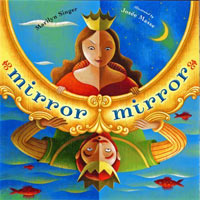
Mirror Mirror: A Book of Reversible Verse

MIRROR, MIRROR

(excerpt)

IN REVERSE

Who
says
it’s true–
down
is
the only view?
If you believe that,
this poem
will challenge
you.
Up
is
something new.
***
Something new
is
up.
You
will challenge
this poem
if you believe that
the only view
is
down.
It’s true.
Says who?

I’m Getting A Checkup

I'M GETTING A CHECKUP

(excerpt)

I’m at the doctor’s office,

waiting for a checkup.

It’s time to get examined

from the neck down to the neck up.

I’m feeling pretty brave,

though I’m still a little scared.

But knowing what each tool is for

helps me feel prepared.