Marilyn Singer had already demonstrated considerable versatility of poetic talents when in 2010 she debuted a new verse form in Mirror Mirror: A Book of Reversible Verse (6–10 years, Dutton). This year she is back with a companion, Follow Follow: A Book of Reverso Poems (6–10 years, Dial; both books illustrated by Josée Masse), in which another cast of folkloric characters get the “reverso” treatment.
 Marilyn Singer
Spicy Reads: An Interview with Marilyn Singer
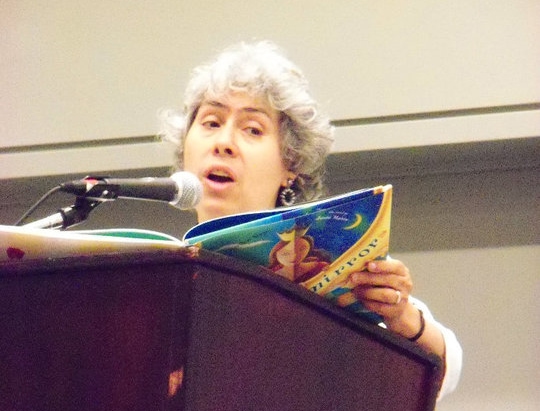
At the Anderson Bookstore Children’s Literature breakfast extravaganza, I was able to steal Marilyn Singer away to speak with me about poetry and students and teachers and caterpillars (among others). Marilyn has published over 100 books for students of all ages. She is delightful. If this video captures even a fragment of her charm, viewers will run out and buy multiple copies of all her books!
Follow Follow: A Book of Reversos
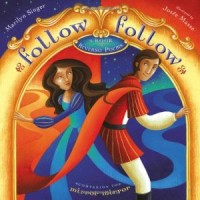
(excerpt)
FAIRY TALES
Read my book.
And then
just imagine this,
me in my garret, working all alone,
how hard it was to write.
I need to tell the world
the truth,
so here goes:
I beg your pardon–
fairies helped.
***
Fairies helped?
I beg your pardon!
So, here goes
the truth:
I need to tell the world
how hard it was to write,
me in my garret, working all alone.
Just imagine this,
and then
read my book.
How to Read a Poem Aloud
Poetry began as an oral art and, with the exception perhaps of concrete poetry, it needs to be heard. But, whether it’s poetry for adults or for kids, it’s not always so easy to read poetry well aloud. Here are some tips on how to do it.
1) Familiarize yourself with the poem. Read it silently and aloud to yourself several times. If it’s written in a particular form, such as a haiku, a cinquain, a triolet, a sonnet, etc., get to know that form. Remember the old joke: How do you get to Carnegie Hall? Answer: Practice, practice, practice!
2) Who’s the speaker of the poem? Is it the poet (or a version of the poet)? Is it a character? If so, what can you tell about this person, animal, creature? What kind of attitude and voice would he, she, or it have?
3) What does the poem mean? What does the title tell you? There may be shades and levels of meaning, but a poem isn’t open to any old interpretation you throw at it. However, don’t always expect to understand it immediately—take your time with it.
4) There may be unfamiliar words in the poem. Look them up. You can build your vocabulary at any age. Learn to pronounce unfamiliar (and occasionally familiar!) words properly.
5) How is the poem punctuated? That can be difficult when there is no punctuation, so you have to figure out the pauses and the stops that make the poem make sense.
6) Study the line breaks, but don’t necessarily pause at the end of every line—including poems in rhyme! Go with the flow.
7) What words need to be punched? On American Idol, Steven Tyler gave a contestant great advice—he said, when you sing, don’t sing everything on the same level. Figure out which words you want to emphasize and why.
8) Don’t read like a robot. What is the emotion behind the poem? How can you convey it?
9) Don’t overdo it either by declaiming or overacting.
10) It’s generally best to slow down when you read. You may think you’re already reading slowly, but you’re probably not. Occasionally, a humorous poem, such a list poem, may suggest speed and it might work to be more of a motormouth. But even then, you have to enunciate (listen to some Gilbert and Sullivan!). Remember to breathe!
11) When you’re reading any poem, timing is important, but perhaps especially in humorous poems. Don’t ever rush the punchline! And above all, have fun
A Deck of Children’s Poets

Fifty-Two Children’s Poets You Should Know
Besides the wonderful Jack Prelutsky and Shel Silverstein, there are many other excellent children’s poets. Here’s a list of fifty-two of them. Look up their books!
| Arnold Adoff
Francisco Alarcon Carmen T. Bernier-Grand Calef Brown Leslie Bullion Stephanie Calmenson Kate Coombs Rebecca Kai Dotlich Margarita Engle Douglas Florian Betsy Franco Helen Frost Kristine O’Connell George Nikki Giovanni Joan Bransfield Graham John Grandits Eloise Greenfield Nikki Grimes Monica Gunning David Harrison Juanita Havill Georgia Heard Lee Bennett Hopkins Mary Ann Hoberman Paul Janeczko Alan Katz
|
Bobbi Katz
X.J. Kennedy Karla Kuskin Julie Larios J. Patrick Lewis Tony Medina Pat Mora Heidi Mordhorst Walter Dean Myers Marilyn Nelson Naomi Shihab Nye Bob Raczka Laura Purdie Salas Alice Schertle Joyce Sidman Marilyn Singer Charles R. Smith, Jr. Hope Anita Smith Joyce Carol Thomas Lee Wardlaw Carole Boston Weatherford Robert Weinstock Allan Wolf Janet Wong Jane Yolen Tracie Vaughn Zimmer |
For more fine children’s poets to discover, go to Sylvia Vardell’s Poetry for Children Blog: http://poetryforchildren.blogspot.com/
A Strange Place to Call Home
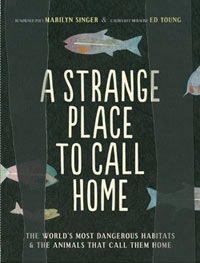
(excerpt)
ON THE ROCKS
limpets
In the intertidal zone,
where waves are prone
to be forceful,
where the waters rush
to batter, buffet, crush,
dislodge, displace, fling,
a limpet is resourceful.
It’s fine construction
employs suction.
In other words, its thing
is mightily to cling.
The Superheroes Employment Agency
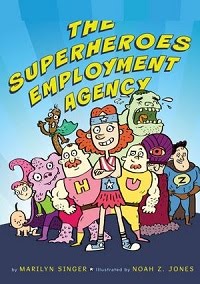
(excerpt)
BLUNDER WOMAN
C.E.O. of the Superheroes Employment Agency
Wherever I worked,
assisted, or clerked,
without lifting a hand,
by a mental command,
I’d make hard drives expire
and planes go haywire.
I might flatten a tire
or ignite a small fire
to watch villains perspire
as I wrecked their empire
through each deliberate error
(my sly reign of terror).
I was never detected.
I was never respected.
I protected good folk–
but I nearly went broke.
So I began this agency
for superheroes just like me:
outclassed, outranked, unsung,
standing on the second rung.
Now we’re proud and confident
(and I can pay my monthly rent).
Tallulah’s Solo
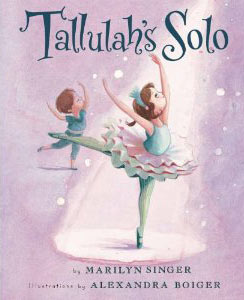
(excerpt)
Tallulah knew she was an excellent ballet dancer. So she was certain that this year she would be doing a solo in the winter recital.
She was sure her little brother, Beckett, would become an excellent ballet dancer, too. She was glad he wanted to learn ballet. She could picture him, back straight, arms graceful, dancing behind her with the other kids while she did her perfect solo.
On the first day of dance school, Tallulah showed Beckett all around the studio. “This is the barre,” she told him. “You hold on to balance.”
“These are the mirrors so you can watch yourself move.” “And this is the chair where you sit if you misbehave.”
“Uh-huh, uh-huh,” said Beckett, but soon he was more interested in sliding on the smooth floor in his new black slippers.
Throughout his class, he paid attention only some of the time. He held first position for just a few seconds before kicking his feet from side to side.
He giggled when the teacher said, “Show me beautiful arms.”
He picked his nose.
Tallulah couldn’t believe that he wasn’t sent to the time-out chair. At the end of class, she told him, “Beckett, you have to pay better attention if you want to be a good dancer…Watch me.”
“Uh-huh, uh-huh,” said Beckett, and he did–for a little while. Then he wandered into the waiting room to play with his toy car.
“Very nice relevé, Tallulah,” her teacher said when she rose and held her balance for a long time.
I will stay up even longer during my solo, she thought with a smile. I will look like a princess in my new tutu and sparkling tiara, and I’ll dance like one, too.
But she wasn’t sure Beckett would be dancing behind her.
Celebrating Poetry: Marilyn Singer, Parts 1 and 2
Marilyn, congratulations are in order. You have five poetry books, as well as a prose picture book, coming out this year…We’ll focus on poetry and talk about two of the poetry books today: The Boy Who Cried Alien and A Stick Is an Excellent Thing and cover the other three in the second part of this interview.
Click here to read Part 1 of the interview with Kate Hosford in CYNSATIONS.
Today, we will discuss Every Day’s a Dog’s Day, The Superheroes Employment Agency, and A Strange Place to Call Home.
The Boy Who Cried Alien
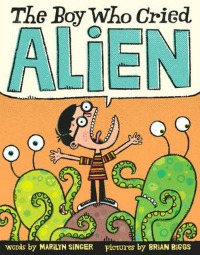
(excerpt)
A sleepy town
A quiet lake
A flash…
SPLASH!
A boy sees the crash landing. Not just any boy. Larry the Liar.
I told my friends that Dad’s a secret agent guy
out searching for the lost world of Atlantis.
That Mom was bitten by a bat and thinks she’ll fly.
Her favorite foods are moth and praying mantis.
I told my class that Bigfoot’s prowling ’round the school.
He really likes to shower in the gym.
The reason why he won’t bathe in the swimming pool
is ’cause a whale arrived ahead of him.
And now a spaceship’s landed in Malarkey Lake.
It looks just like a giant gold-capped tooth.
It’s over there and I can swear it’s not a fake.
What could I say that’s stranger than the truth?
As Larry watches, a pair of unhappy aliens emerge from their ship…
Tapuk tocker, on eorm sag.
Yo yev! Thoos em won
nhew eh kooks ni eht earagg,
Pop lilw eavh a zon.