Chester, The Out of Work Dog

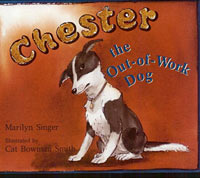
CHESTER, THE OUT OF WORK DOG

(excerpt)

There were two things Chester loved most in the world – his family and his sheep.

Chester’s family was named Wippenhooper.  There was Ma Wippenhooper, Pa Wippenhooper, and their children, Claude, Maude, and Willy.  The Wippenhoopers all looked different.

The sheep all looked pretty much the same. But Chester could recognize each and every one.  He had to.  It was his job.

Every morning after breakfast Chester would herd his sheep out of their pen to a pasture.  Every evening he’d bring them back.  He ran ahead of the sheep and showed them where to go.  He steered them left.  He steered them right.  He charged and chased to keep them all in line.  He made sure not one of them got lost or hurt along the way.  He was very good at his work.

At night when his work was done, Chester would settle down happily with the Wippenhoopers first to listen to a little television and later to the quieter country sounds of the wind in the apple trees, the crickets in the grass, and the distant bleat of his sleepy sheep.  Then, curled up on Willy’s bed, Chester too would fall asleep and dream nothing but pleasant dreams.

But one day the Wippenhoopers sold the farm. They packed their belongings into a big truck and moved to town. Chester went with them. His sheep stayed behind.

In My Tent

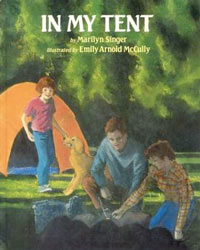
IN MY TENT

(excerpt)

On the day the twins were born
Dad promised me my very own tent
The snow was falling fat flakes on the river
like feathers from my pillow
when I have a fight with Jon
It was hard to think of sleeping under the stars
with the tricky wind tickling our noses nibbling our ears
But Dad bent his head to the frozen ground “Listen hard,”
he said “and you can hear spring snoring”
So I bent too and listened and heard a tiny
puh puh puh gentle as a baby’s breath
“She’ll be getting up soon,” Dad said
But we tiptoed all the way home
so she wouldn’t wake up yet

The Golden Heart of Winter

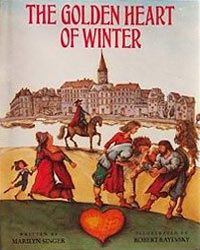
THE GOLDEN HEART OF WINTER

(excerpt)

When the leaves were crisping and the grass glowed in its final burst of green, a blacksmith felt the autumn in his sinews, laid down his hammer on his anvil, and called to his three sons.

“No one can make a sword that sings like I can,” the eldest was boasting.

“My knives are so fine, they fly from their masters’  hands without being thrown,” the second son bragged, waving a dagger before him.

“Enough!” bellowed their father.  “Be quiet and listen to me.”  He looked around the forge. “Where is Half?”

“Here, Father,” his youngest son said from the corner where he’d been watching a mouse. Half, so named by his brothers, did not make knives or swords.  No one would let him near the forge, for they all thought him a fool.  Instead, he fetched wood for the furnace and cleaned out the ashes.  And he was very good at soothing the horses that had to be shod.

The blacksmith looked at his sons and shook his head sadly.  “I am tired,” he said.  “I am growing old.  Soon I will lay down my hammer for the last time.  I would have all three of you run this smithy, but I see that it cannot be.  Therefore, one of you alone must take my place.”

“Then that one shall be me,” said the eldest son.

“No, no.  It shall be me,” insisted the second son.

Half said nothing at all.

The blacksmith raised his hand.  “Listen well and learn how I shall choose my heir.  Go forth, each of you, and bring back something of value.  Whatever is worth the most will mark the master of this forge.”

The two eldest sons looked at each other.  Then they turned to Half, who was studying a beetle scuttling across the floor.

“This half-wit as well is to go on such a quest?”  The eldest laughed.

“Yes, he will go.  He, too, is my son.”

“But, Father…” the second son began.

“No more words.  There will be time enough for words when you return.”

Nine O’Clock Lullaby

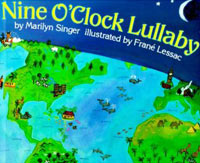
NINE O'CLOCK LULLABY

(excerpt)

9 p.m. in Brooklyn, New York

The vroom and shush of traffic

outside the bedroom window

while Mama turns the pages

of a sleeptime tale.

9 p.m. in Brooklyn, New York, is…

***

10 p.m. in Puerto Rico

Sweet rice, fruit ice, coconut candy.

Papa playing congas, Tio his guitar.

Swaying lanterns in the branches,

dancing people on the grass.

Bedtime is forgotten on a special party night.

10 p.m. in Puerto Rico is…

***

Midnight on the mid-Atlantic

Nothing blacker than the water,

nothing wider than the sky.

Pitch and toss, pitch and toss.

The Big Dipper might just ladle

a drink out of the sea.

Midnight on the mid-Atlantic is…

***

2 a.m. in England

Bread in the pantry at nighttime

tastes better than cream cakes at tea.

2 a.m. in England is…

Exotic Birds

(excerpt)

INTRODUCTION

You are walking through a jungle in South America.  High up in a tree you see a monkey swinging by its tail.  A shadow passes overhead.  Zap!  Before you can blink, sharp claws grab the monkey and carry it away.  you have just seen a harpy eagle getting its dinner…

It is a hot, dry day.  Your jeep is moving slowly through the African plain.  Up the road watching you is a tall, long-necked figure standing on two scaly legs.  You drive a little closer, and, whoosh, off it goes, dashing across the brown grass at forty-five miles per hour.  Quick, snap a picture!  It’s an ostrich on the run…

You have been in cold places before, but no place is as cold as this.  it’s a good thing you’re only visiting.  Who or what, you ask could live at seventy-five degrees below zero?  Then you see them, thousands of them, huddled together, each with an egg on his foot.  What are they?  Emperor penguins, spending the whole winter in a world of ice…

Harpy eagle, ostrich, emperor penguin.  What do all of these strange creatures have in common? They are birds–exotic birds.

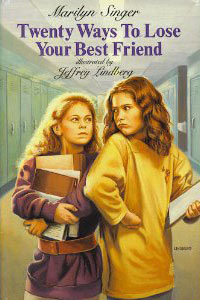
Twenty Ways to Lose Your Best Friend

Chapter One

The President of the United States made me lose my best friend.

He doesn’t know he did.

And Sandy,  my once best friend, doesn’t know it was his fault either.

It’s rotten not having a best friend.  it’s more alone than being alone.  When you’re alone, but you have a best friend, you always know you’ll see her soon and then you won’t be alone anymore.  But when you’re alone without a best friend, you feel you’re going to be alone forever.  Which is how I feel right now.

But I guess I’d better begin at the beginning.

It was Election Day.  We were having dinner–Mom, Dad, my older brother, Ronnie, and me. Mom was mad.  She’s mad a lot.  We’re all pretty used to it, especially since she isn’t usually mad at us.  It’s other things that get her angry–things other people do.  “Most people have small minds,” she says.

Dad teases her sometimes.  He hardly ever gets angry.  He says getting angry won’t help people’s minds get any bigger.

Anyway, at dinnertime on Election Day Mom said, “You know, I voted this afternoon.”  She plopped some mashed potatoes on my plate.  “While I was on line, I heard two men talking. Ooh, they made me mad.”  She poured some gravy on my potatoes.  It splashed over the side.  “One of them said to the other, ‘I don’t think he’s as good as the other guy.  But I went to school with him, so I’m voting for him.’  Isn’t that the dumbest thing you ever heard?”

She went over to Ronnie.  He was reading a comic book.  “You should vote for who you think is the best person to be president.  You shouldn’t vote for someone just because you know him.”  She dumped some potatoes on Ronnie’s plate.  Some of the potatoes fell off on him.

“Ma, watch out!” he yelled.  He held up his comic book.  It had potato lumps all over it.

Mom frowned and grabbed the comic book out of his hand.  “You shouldn’t be reading at the dinner table.”  She put the comic on an empty chair and carefully poured gravy on Ronnie’s potatoes.

Next she brought the potatoes and gravy to Dad.  She started to dish them out, but he took them from her.  “I’m right, aren’t I, Richard?” she said.

“Yes.  Ronnie shouldn’t read at the table.”

Mom made a face.  “I meant about voting for the best person.”

“Oh, well.  Yes, I think you’re right, Jane.  But I can understand how the man you heard felt.  A lot of people would vote for a friend even if he or she weren’t the best person for the job.”

“A lot of people have small minds,” Mom said.  Then she looked at me.  “What do you think, Emma?” she asked.

“I don’t know,” I said.  “I’m too young to vote for the president.”

“That’s true.  But you never know.  Someday soon you might have to choose between a friend and someone else for some job…Now, eat your potatoes.”

“Okay, Mom,” I said.

I didn’t think about what Mom said anymore that night.  I didn’t really think I was going to think about it anymore at all.

Boy, was I wrong.


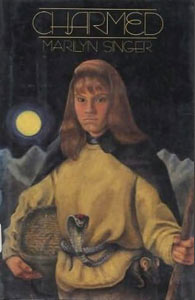
Charmed

(excerpt from Chapter One)

Sss came the sound again.

Miranda’s hand froze in midair.  Her skin prickled.  “It’s coming from my room,” she said.

Slowly she walked down the hallway.  With each step, the noise grew louder, nearer.  Maybe it’s the wind, she told herself.  But she knew it wasn’t windy out.

Her door was closed.  She didn’t remember closing it.  The hiss was making it rattle and hum.  Swallowing hard, Miranda grasped the doorknob.  It felt icy cold.  She shivered and dropped her hand.  Suddenly, she let out her breath.  “This is ridiculous,” she said.  “I’m being silly.”  Once again seizing the knob, which was now at least ten degrees warmer, she opened the door.

The noise stopped immediately.  She switched on the light.  Everything looked the same–her desk, her dresser, her bed.  Nothing was out of place.  She went over to her closet and flung open that door.  She could see clear to the back, and there was nothing inside except for her clothes, hung neatly as ever.

Maybe it’s some kind of bug.  A cicada or a katydid, she thought.  But she vaguely recalled it wasn’t the time of year for either one.  She sat down on her bed for a while.  I wish Bastable would come back, she thought sadly.  Then she remembered the cookies.

She jumped up, heading for the door, and nearly tripped.  “What the…”  She looked down at her feet.  Uncle Gerald’s basket was lying there.

How did it get here this time? I know I put it over there just this afternoon, stupid thing. She picked it up, nearly threw it in its corner, and left the room.

She stopped in the kitchen, put Bastable’s cookies on a plate, then went back to the living room where she watched TV for a long time with the sound off, making up her own dialogue for the succession of sitcoms and cop shows.  At last, she decided she might as well go to bed.  She brushed her teeth, washed her face, and turned out all but the front hall light.  Then she padded to her room.

The door was open as she’d left it.  With a small sigh of relief and fatigue, she walked inside and flicked on the light switch.  But no light came on.  With a bang, the door slammed shut behind her, and the hissing began again.  There was no doubt this time where it was coming from.  It was coming from the basket–shining like a small silver spaceship right on top of Miranda’s bed.

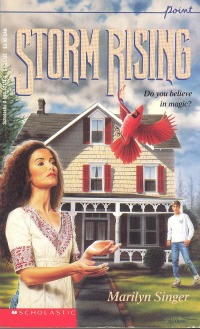
Storm Rising

Storm Rising

(excerpt from Chapter One)

It was the dog.  Or the dog was me.  It didn’t matter how you said it.  Yeah, I was drunk, but it was true all the same.

The dog was nosing around under the weeping willow near the lake.  I couldn’t make him out well in the dark, except that he was long and scrawny and busy looking for something–a snack, a place to flop for the night, a friendly female.  Whatever it was, he had no one to help him find it.

“Hey, dog,” I called.  “Listen to this:  ‘When in disgrace with Fortune and men’s eyes/I all alone beweep my outcast state…'”

The dog kept on about his business.

“Don’t like that one?  Not big into Shakespeare, huh?  How about this, then?”  And I sang to him about it being another Saturday night and me with nobody.

The dog still didn’t look up.

“Okay for you, mutt.  Here I offer you the kind of camaraderie only the lonely can share, and what response do I get from you?  Zero.  Zilch.  Nada.  Well, okay, ignore me.  See if I care.  In fact, I care as much about you as Vicki cares about me.”

I got dizzy then and I stretched out on the grass, but I didn’t break my train of thought.  Vicki.  Oh, Vicki.  Long blonde hair, long lean legs, and the most beautiful breasts I’d never seen.  Vicki, who looked like a Sunday in June–and acted like a Monday in February.  Vicki, my girlfriend, depending on which hour of which day of which week you were referring to.  And if it was the past hour, no dice.

I had showed up at her place forty-five minutes early.

“Storm,” she said.  “You said nine o’clock.  I’m not ready.”

“Yeah.  Sorry.  But you look ready…”

“Well, I’m not–and besides I don’t want to get to Gary’s too early.  Nobody’ll be there yet except a couple of other guys, and you’ll be talking baseball and I’ll have to go into the kitchen to make the dip and all the stuff Gary didn’t get around to doing.”

I didn’t bother to remind her that I never talked baseball with anybody.  I didn’t know diddly-squat about baseball.  “So, take your time,” I said.  “I’ll hang out with your folks, watch TV.  They won’t mind.”  I smiled.

“Look, Storm.  You keep doing this.  Every Saturday night you say you’re going to be here at a certain time and you show up hours early.  How come?”

“How come?” I asked, smile wavering a little.

“Yes, how come?”

“Well, sugar, it’s because I always overestimate the number of hours I can bear to be apart from you.”  I fixed my smile back in place.

“Hand me another one, why don’t you?” she sneered and marched upstairs to her room.

I went and watched TV with her folks.  They didn’t mind.

At nine-thirty precisely she came into the den.  “I’m ready to go,” she said. Those were her first and last words to me for the next two hours.

Maybe I should have told her the truth about the Saturday Night Frolics with Sunny and Boyce.  Picture this, I could have said:

Storm Ryder, so named by his mother, Sunny, in a rare burst of wit, has just finished washing the dishes after also cooking and helping consume the dinner for three.  This is not unusual.  Storm has been doing these chores on an average of six nights a week for the past ten years.  He also makes breakfast, cleans the house, irons and mends his own clothes and mows the so-called lawn on a regular basis.

Sunny is taking a bath.  Storm can hear her wobbly soprano singing “Teach Me Tonight” over the running water.  In their small five-room house, anybody can hear almost anything anytime.  Storm is glad he took a shower two hours ago when he got home from his exciting summer busboy job before Sunny used up all the hot water.  The heavy smell of Jean Naté bath oil seeps into the kitchen.

Boyce Owens, Sunny’s most recent and longest staying “house guest,” leans against a counter, whistling.  “Bet you’re in a hurry to get over to that cute blonde’s house, huh, kid?” he says to Storm.  “Guess she likes ’em skinny.”  He jabs Storm in the bicep.  “Well, there’s no accounting for taste.”

“You can say that again,” Storm mutters.

“What was that?”

“Nothing.”

Boyce studies Storm.  “Jeez, your mama doesn’t feed you enough.”

“My mama doesn’t feed me at all,” Storm replied, louder this time.

Boyce gives a hearty laugh.  “Guess that’s so.  Well, you need more carbs.  And you should weight train.  Start with thrity pounds, twelve reps, and in a month or two you’ll be up to sixty.  Then you can come work for me.  Nothing like hefting drywall every day to build you up.”  He pokes Storm again.

The sounds of Sunny singing and splashing suddenly cease.  Boyce begins to him. Storm dries the dishes.  Five minutes pass.  Then Sunny, in a blue satin negligee, comes into the kitchen.  “Oh, Storm,” she says, her eyes, if not her mouth, frowning.  “You’re still here.  Aren’t you going out tonight?”

Storm pauses.  “Well, I don’t know.  I thought maybe I’d stick around…”

Sunny’s eyes frown harder.  “Really?  That might not be convenient.  Boyce and I have plans.”

“He’s pulling your leg, honey,” Boyce tells her, putting his arms around her waist.  “I heard him on the phone this morning.  He’s got a hot date tonight.”

“Oh.”  Sunny smiles.  “Well, why don’t you let me finish the dishes so you can go.”  She takes the lone remaining plate from the sink and begins to dry it.

“Gee, thanks, Mom,” says Storm and lopes out the door.

Yeah, I could have told Vicki all that.  But I didn’t feel like it.

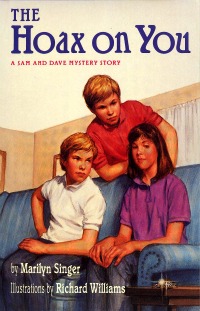
The Hoax On You

Chapter One

“Hey, Sam,” said Dave, glancing up from the magazine he was reading.  “Do you believe there’s life on the moon?”

“Huh?” Sam, his twin brother, looked up, holding his hands stiffly in front of him. His fingers were coated with bits of paper and glue.  He was trying to make a birthday card for his friend Rita O’Toole and not doing a very good job of it.  Dave had finished his card half an hour ago; it was perfect.  “What did you say?” Sam asked.

“I said, do you believe there’s life on the moon?”

“No.  Nobody does.”

“They did in 1835.  It says here in Funtime magazine that in 1835 a newspaper called The Sun printed a bunch of articles which claimed that a British astronomer looked through a new and powerful telescope and saw buffaloes, goats, birds, and, last, but not least, furry little winged men on the moon,” Dave told him.

“That’s ridiculous.”

“Yeah.  But people believed it–and the newspaper sold lots and lots of copies. That was one successful hoax.”

Sam shook his head.  “Wow!  I wonder how many hoaxes there have been.”

“Lots.”  Dave glanced down at Funtime. Here’s one about a guy who fooled everyone into thinking he was a wealthy lord and another about a photographer who claimed he could take pictures of ghosts and other hoaxes too.  And pretty soon, because of this magazine, there are going to be a lot more.”

“What do you mean?”

“The editors are having a hoax contest.  Whoever pulls off the best hoax wins.”

“Wow!” Sam exclaimed, clasping his knees.  “Do you want to enter it?”

“I don’t know.  Maybe.  It seems to me a pair of identical twins who also happen to be detectives should be able to come up with a pretty good hoax,” Dave said, eyes twinkling.

“Yeah!”  Sam grinned.  He picked up his hand to slap five.

“Yuck!” Dave exclaimed.

Sam looked down at his hand.  It was still covered with some paper and glue, but not as much as his knees were.  “Oh no.  What a mess.”

“Better wash your pants before Mom sees them.”

Sam nodded, but before he could even get up, he and Dave heard their mother open the front door.  Sam swallowed.  “You don’t suppose,” he said slowly, “we could pull a hoax on Mom, switch pants and pretend I’m you, do you?”

“Sam, I don’t think Mom would ever believe you’re me,” Dave said, trying not to grin.

“I was afraid you’d say that.”  Sam sighed.

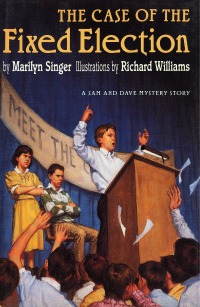
The Case of the Fixed Election

Chapter One

Brad Cohen Is Not A Clone

He’s Got A Brain That’s All His Own

Vote Cohen For President

read the sign.  A chunky, dark-haired boy was tacking it on the bulletin board near the school cafeteria.

A short, wiry girl in a yellow dress rushed up to the board and planned another sign squarely next to his.  This one said:

Elect Corky Lemon For President

Because This Lemon Is A Peach

The two sign posters took a moment to admire their handiwork.  Then they turned and glared at each other.

“You don’t have a chance, Lemon,” sneered the boy.

“That’s what you think, Cohen,” answered Corky.  With a toss of her head, she marched past him.

Brad thumbed his nose at her and galumphed off in the opposite direction.

“Those two don’t like each other very much,” said Dave Bean to his twin brother, Sam.

Sam wasn’t really thinking about what Brad and Corky thought of each other. Instead, he was marveling at how fast they (and their campaign managers) had worked.  Their signs were all over the school already.  Dave was running for Student Council president too, and Sam was his campaign manager.  But not only hadn’t they put up his signs, they hadn’t even made them yet.  They couldn’t seem to come up with a good slogan.  Before Sam had a chance to say anything, Jack Dodge, the only candidate for vice president, said in his nasal voice, “As a reliable witness to the preceding incident, I’ll corroborate that.”

Sam looked at him blankly.  Jack’s father was a lawyer, and Jack was always using big legal words and phrases hardly anybody understood.  It was annoying. Jack was annoying.  But when it came to “good causes,” he was also the hardest-working kid in the school.  Right now he had a petition he wanted Sam and Dave to sign.  It was about saving some big trees near the school that a developer wanted to cut down.  Sam and Dave read the petition.  While they were signing it, Jack asked, “Where are your posters, Dave?”

“We;ll be putting them up soon,” Dave said, thinking that that had better be true. “What do we have so far, sloganwise?” he whispered to Sam as Jack dashed over to their gym teacher to get his signature on the petition.

Sam pulled out the notebook and read, “‘Dave Bean–he’s keen’; ‘Dave Bean is no beanbag’; ‘Vote for Dave–one of the best human Beans around.'”

“Ugh, ugh, and ugh,” said Dave.

“Yeah.”  Sam nodded.

Jack rejoined them.  “Well, I want to wish you good luck on your campaign, Dave. You’ll be getting my vote.  It’s no mystery you’re the best candidate for the job.” He patted Dave on the back and charged off into the cafeteria, waving his petition like a flag.

Sam and Dave looked at each other.

“It’s no mystery…” Dave began.

“You’re the best candidate for the job,” finished Sam.

“Not a bad slogan, with a few changes…”

“…for a famous detective.”

Sam and Dave slapped five.  “Thanks, Jack,” they chorused to the empty hall. Then, laughing, they went into the cafeteria to eat lunch.

That evening they worked on the posters.  Sam picked out the colors; Dave came up with the design; and they both did the lettering.

“These look great,” Dave said when they finished.  “Let’s go in early tomorrow to put them up.”

“Yeah,” agreed Sam, wondering if Brad and Corky had left them any wall space. Brad, Corky, and Dave, all of them running for president and all of them wanting to win.  Sam thought his brother had a god chance, but he wasn’t a shoo-in. Brad was pretty popular, and Corky had a lot of friends too.  It was going to be a tight race.

“I hope it’ll be a clean on,” Dave said.

“What?” Sam looked up at him.

“The election.  With the way Brad and Corky are acting, I hope there won’t be any dirty tricks.”

“Do you think there will be?” Sam asked.

Dave hesitated a moment, then shook his head.  “No,” he said.  He repeated it firmly.  “No.”

But Sam didn’t think he looked so sure about it.